Tuesday, November 30, 2010

FreshFish and FatCat


Saturday is my cooking day. It is the day when I usually try out different recipes. One of the interesting recipes I tried was the famously hot and spicy Manado (also known as Minahasa) cuisine called Cakalang Rabe Rica which can be translated to ‘Hot Spicy Shredded Tuna’.


Why Manado?


As the chili lover, I cannot resist to try hot spicy recipes. Since I started my cooking journey, I have tried cooking many hot spicy recipes from different areas in Indonesia but so far have not tried any recipe of Manado cuisine which are known to be bloody hot and spicy.


Manado is the capital of the North Sulawesi province of Indonesia. It is located at the Bay of Manado, and is surrounded by a mountainous area and is famous for its Bunaken Sea Garden, one of the most beautiful sea gardens in the world. And this is the picture of Bunaken:


Why tuna?


Manado is famous with its cakalang fish which is also known as flying fish. Cakalang is from the same family (Scombridae) with tuna fish.


Tuna fish are truly a nutrient-dense food. An excellent source of high quality protein, tuna are rich in a variety of important nutrients including the minerals selenium, magnesium, and potassium; the B vitamins niacin, B1 and B6; and perhaps most important, the beneficial omega-3 essential fatty acids .


Speaking of tuna, guess who’s waiting faithfully in the kitchen when I was busy preparing to cook the Hot Spicy Shredded Tuna?


It was Miu Miu…our beloved FatCat (note: her weight is 6 kg).


Yeah, Miu Miu was there with me in the kitchen, waiting patiently hoping to get a little bite of her favorite fish (note: her favorite cat food is chicken and tuna).


By the way, I just found out that there’s a difference between ‘cat tuna’ and ‘people tuna’. The cat version has all the necessary ingredients added to it to make it healthy for the cat to eat it. Giving ‘people tuna’ to cat as a very rare treat will be okay, but not as part of cat’s daily diet. Why? Human-grade tuna can be high in phosphorous and other metals that could harm a cat if fed regularly.


Well, enough about Miu Miu the FatCat and let’s go back to my cooking Hot Spicy Shredded Tuna or ‘Tuna Rabe Rica’.


Here is my version of Tuna Rabe Rica


Ingredients :
  • 500 gram fresh tuna fish meat (the original recipe used smoked Cakalang fish)


  • Grill the tuna meat until dry, then shredded

  • 10 Kaffir lime leaves, take out the hard part, thinly sliced
  • 2 cm ginger, bruised
  • 2 cm galangal, bruised
  • 5 stalks of lemongrass, take only the white part, bruised
  • 5 pandan leaves, tie into a knot
  • 2 teaspoon of lime juice
  • 10 tablespoons vegetable oil
Grind the following spice ingredients into a paste:

  • 20 finger-length red chili peppers, chopped
  • 10 red bird’s eye chilies, chopped
  • 20 shallots or 3 big size onions, chopped
  • salt and pepper
  • 1 teaspoon brown sugar (optional)
How to make:

  • Heat the oil on medium heat
  • Stir fry the spice paste
  • Add in the Kaffir lime leaves, lemon grass, ginger, galangal, pandan leaves and stir fry until fragrant
  • Add in the shredded tuna meat, stir and mix well with the spice
  • Add in the lime juice, salt, pepper and sugar (if used)
  • Continue to stir fry around 10 – 15 minutes until the tuna is really mix well with the spice
  • Remove from heat
  • Discard the pandan leaves, galangal, ginger and lemon grass
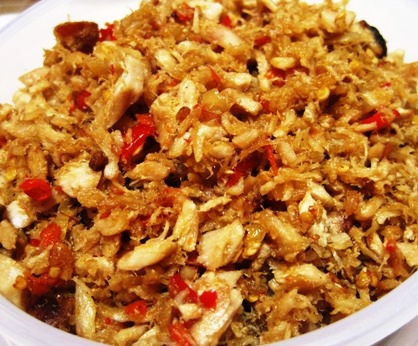


Serve warm with rice


Monday, November 22, 2010

Cook Chili When It Rains

Rainy days are here again in the city where I live. As a person who grew up in the tropics, I adored the rain. Normally, we have two seasons: the dry and wet season. This year we had very short dry season so by now, the weather has been so wet and chilly.


We can have a bright sunshine in the morning but suddenly comes the thick dark cloud followed by lighting, thunder and heavy rain or we can have gloomy cloudy sky with the rain showers all day.


And when rain falls heavily for a few hours or showers down all day, this is what will happen in the city:


When you live in a city like Jakarta, it's either you become bitter or better.... let's choose to become better.

Rainy day holds one certainty in the realm of food – Chili. One spoonful of the spicy stew can warm the body from the inside out.


Chili is a must-have rainy-day-dish, enjoyed equally at a cook-out or dinner party – and especially as leftovers. The one great thing about Chili is the recipe is really kind of a guideline and we can change it depending on our tastes.


One of my favorite Chili dishes is Chili con Carne coz its sooo tasty, hot, healthy and easy to make! It’s best to enjoy during the rainy days like now.


You can have Chili either on its own, with rice, potatoes, pasta, nachos ….you name it!


What is Chili con Carne?


Chili con Carne (literally “Chili with meat”, often known simply as chili) is a spicy stew. The name “chili con carne” is taken from Spanish which means “peppers with meat.” Traditional versions are made, minimally, from chili peppers, garlic, onion and cumin, along with chopped or ground beef. Beans and tomatoes are frequently included. Variations, both geographic and personal, may involve different types of meat as well as a variety of other ingredients.


It can be found worldwide in local variations and also in certain American-style fast-food restaurants. The variant recipes provoke disputes among aficionados, and the dish is used as an ingredient in a number of other foods.


My Version of Chili con Carne


Ingredients:


  • 500 gram ground/minced beef
  • 1 Large onion chopped
  • 2-3 Cloves of Garlic
  • 250 ml beef stock
  • 1 tin of red kidney beans, drained and rinsed. This is the kind of red kidney beans I use


  • 7 fresh jalapeno chili peppers, coarsely sliced. Why seven? no special reason, I just like it (in my country jalapeno pepper is called cabe gendot)


  • for the tomatoes, we can use chopped fresh tomatoes (400 gram) or canned tomato paste (around 100 gram).

For the seasoning:


  • 1 teaspoon chili powder
  • 1 teaspoon paprika
  • 1 teaspoon oregano flakes
  • 1 teaspoon ground allspice
  • Brown sugar to taste (optional)
  • Pinch of salt and pepper
notes: in the original recipe, it uses 1 teaspoon of ground cumin but in my recipe I skip the cumin.


How to make:


  • Heat a small frying pan over medium heat and dry-fry the allspice, chili and paprika for 1 minute or until fragrant. Remove from pan.
  • Heat the oil in large skillet over medium heat and cook the onion for 2-3 minutes or until soft.
  • Add the garlic, fresh jalapeno and cook for 1 minute.
  • Add the ground/ minced beef and cook over high heat for 4-5 minutes or until browned, breaking up the lumps with a fork.
  • Add the tomatoes, red kidney beans, stock, oregano, sugar and spices.
  • Reduce the heat and simmer, stirring occasionally for around 1 hour or until reduced and thickened
  • Season with salt and pepper
  • Remove from heat Serve warm in a serving bowl


  • Or add the Chili on top of fried potato wedges


How do you take your chili? With beans? Without? With meat? Without? Please Share your favorites in the comments.

Thursday, November 18, 2010

The Touch of Mother’s Love


All of us must have different experiences with Mother’s love. I know I have. They run like threads through my childhood. And it was my Mom’s love that made me took the first step of my cooking journey hence this blog as it was her who taught me to enjoy home meals.


Looking back to that childhood moment, feeling of warm and joy rise even now to meet me. I always felt safe and loved whenever I enjoyed my Mom’s cooking.

During my childhood, our country had for some years been struggling through economic difficulties. My father had meager salary and grocery money was scarce. We were fortunate that my Mom was excellent in managing the little money we had so that none of us, her children, felt the difficult situation. She was also a great cook. She knew how to prepare very simple dish in a way that made it seem like rare delicacy

One of the dishes my Mom often cooked for us during that difficult time was Vegetable Scramble Eggs or locally is called ‘Orak Arik’ which means scrambled. Orak Arik is a popular Javanese cooking. It was a very simple dish, the main ingredients were just vegetables and eggs. But it was the touch of my Mom’s love which made this simple dish into something special for us.

Here is the original of my Mom’s recipe of Orak Arik

Ingredients:

  • 1/4 of medium size white cabbage, shredded
  • 100 gram carrots, grated coarsely
  • 2 cloves of garlic, thinly sliced
  • 4 shallots, finely sliced
  • 2 eggs
  • 1 chicken cube, crushed into powder form
  • Pinch of salt and pepper
  • Vegetable oil

How to make:

  • Heat the oil in wok on medium heat
  • Stir fry the onion and garlic until fragrant
  • Add in the white cabbage and carrots
  • Continue to stir fry until the vegetables are tender-crisp
 

  • Make a well in the center of the vegetables and drizzle in a teaspoon of oil before cracking the eggs into it


  • Stir to scramble the eggs and combine with the vegetables
 

  • Add the crushed chicken powder, stir and mix well
  • Add salt and pepper, continue stirring for a few minutes
  • Remove from heat
  • Serve warm

    When I cook this dish, I like to add  chopped bird’s eye chilies in the vegetable mix to give a kick .
    

Monday, November 8, 2010

Meet the Meatballs


For quite sometimes, the noodle lover in my family has been nagging me to cook her spaghetti with meatballs. So far I have cooked different spaghetti dishes such as spaghetti Bolognese, spaghetti with tuna and chili, spaghetti with mushroom and tomato, spaghetti olio e aglio plus bacon an chili, spaghetti Carbonara and even classic lasagna but never have I tried spaghetti with meatballs.


Last night when I turned on my TV and watched one of my favorite channels the TLC (Travel Living Channel), it was showing the famous Take Home Chef program. It was already almost the end of the show and I only watched the part where Curtis Stone showed how to cook the pasta until ‘al dente’. Then he put butter on a pan, melt it on medium heat, and then add the pasta (spaghetti) into the melted butter and toss them with fork. He then showed how to serve the pasta by rolling the spaghetti with a fork and put them on a plate and add the sauce. It just so happened that Curtis was cooking spaghetti with meatballs


After watching the Take Home Chef program that night I decided to cook spaghetti with meatballs the next day. Since I missed the part where Curtis cooked the meatballs I had no idea how to cook them so I browsed through my cooking book collections and found a recipe called ‘Fusilli con Polpettine’ or Fusilli with meatballs in one of the Periplus Mini Cookbooks . At least I could try this recipe.


As always, before I try out a new recipe, I like to do a little desk research and this time I did my research on ‘Polpette’

Why Polpette?

Polpette is the Italian name for meatballs. They are in many ways a holdover from an earlier time, when refrigeration was not as dependable as it is today and trimmings and leftover meats had to be dealt with quickly or they would spoil. Polpette, are true home cooking of the sort you are unlikely to encounter in any but the most mom-and-pop type trattorias that cater to a local clientele. Nor are you likely to be served them if you are invited to someone’s house, unless you are considered family.

A pity, in some ways, because meatballs are easy to make, flavorful, and delightfully moist and tender too. One thing that may come to a surprise to people living outside the Peninsula is that in Italy they’re generally served as a second course, with a salad or vegetable; spinach and beet greens are especially popular in Tuscany.


One general note on technique: Italians often use bread — not bread crumbs — in meatballs: Take day-old Italian bread, trim away the crust, soak the bread for several minutes in milk, and squeeze most of it out. You don’t want it dribbling-soaked, just well moist. Mix the soaked bread into the ground meat.

And here is my version of Spaghetti with Meatballs or Spaghetti con Polpettine


Ingredients:


  • 250 gram spaghetti
  • 250 gram minced beef
  • 50 gram bread crumbs
  • 20 gram freshly grated Parmesan cheese
  • 1 egg, beaten
  • 1 onion, chopped
  • 1 clove garlic, chopped
  • Rind and juice of half lemon
  • Salt and pepper
  • 2 tablespoons seasoned flour
  • Extra Virgin Olive Oil (EVOO)
  • 20 gram butter
Ingredients for the sauce:

  • 100 gram tomato paste or puree
  • 125 ml beef stock
  • 125 ml red wine
  • 1 clove garlic, crushed
  • 1 teaspoon oregano powder
  • Salt and pepper
How to make:

  • Peel the onion and chop very finely
  • Using your fingers combine the minced beef, bread crumbs, Parmesan cheese, chopped onion, egg, lemon rind and juice, salt and pepper in a large bowl.
  • Roll tablespoonful of the mixture into balls then roll the balls in the seasoned flour


  • Heat the oil in a large pan and the fry the meatballs in batches until golden
  • Remove from pan, drain on paper towels and set aside.


  • Drain excess oil and juices from pan

To make the sauce:


  • Combine tomato paste / puree, beef stock, wine, oregano, garlic, salt and pepper in pan and bring to the boil.
  • Reduce the heat and return the meatballs to the pan
  • Simmer for 15-20 minutes


  • Meanwhile, add the spaghetti to a large pan of rapidly boiling water and cook until ‘al dente’ then drain.
  • Put the butter on another pan and melt it on medium heat
  • Add the spaghetti on the melted butter and toss it with a fork
  • Roll the spaghetti using the fork and place them on the serving plate
  • Add the sauce with the meatballs around the spaghetti


When I serve this spaghetti with meatballs to the noodle lover, she was very happy.

Friday, October 15, 2010

Frying the Fritters Family

One saturday, when I was busy in the kitchen, my second daughter came in ’to help me’ by tasting whatever I had been cooking. She knows that when I was busy cooking, it means not long after that I would be busy writing my blog. And this time she even helped me with the title of this post ‘Frying the Fritters Family’ and …..also suggested to try to read it 10 times faster


Why fritters?

We have so many different types of fritters in this country and basically almost any type of food can be turned into fritters: banana, jackfruit, breadfruit (sukun), noodle, vegetables, tofu, shrimp, tempeh, sweet potato, button mushroom, spaghetti, cassava, corn.. ….you name it.

And we call all these different fritters ‘gorengan’ which literally means ‘fried foods’. Yes, they are all deep fried and most Indonesians love ‘gorengan’. The most famost ‘gorengan’ is the one sold by street hawkers.


We have a quite unique habit of eating fritters. We usually eat fritter with green bird eye chilies (= cabe rawit) by taking a bite of the fritter and then a bite of the chili. We eat fritters as snack at any time of the day and the best way to eat them is when you get together with friends. In the office where I work, we often buy ‘gorengan’ from street hawkers outside the office building and eat them together during afternoon coffee break. I can say this is typical Indonesian or at least Asian habit since most of our Western expatriate colleagues are amazed on how we love snacking and even some of them say that we snack all the time.

Back to one saturday in my kitchen, I tried to fry different fritters that day and let’s meet some members of the Fritters Family:

Corn Fritters

Ingredients:

  • 250 gram corn kernels, boil in water until soft, drained
  • 50 gram shrimp, chopped
  • 50 gram of all purpose flour
  • 1 tablespoon of chopped coriander leaves
  • salt and pepper
  • 2 eggs, beaten

How to make:

  • Put the boiled corn kernels in a bowl
  • Add in the chopped shrimp, coriander leaves and flour, mix until blended well
  • Add salt and pepper
  • Add the beaten egg, stir and mix well
  • Drop batter by rounded tablespoonfuls, and fry, in batches, 5 minutes or until golden brown
  • Drain fritters on paper towels
  • Serve warm with bird eye chilies


Mushroom Fritters

Ingredients:

  • 200 gram button mushroom, clean with paper towel to remove the dirt, cut each into half
  • 50 gram of all purpose flour
  • 10 gram of corn flour (optional, to make the fritters more crispy)
  • Pinch of salt and pepper
  • 2 eggs, beaten

How to make:

  • Put the mushrooms in a bowl
  • Add in the all purpose flour, make sure all mushrooms are covered
  • Add in the corn flour, salt and pepper and mix well
  • Pour in the beaten eggs until well coated
  • Deep fry in batches in a frying pan or wok on medium heat until golden brown
  • Remove from heat, drain fritters on paper towels
  • Serve warm


Noodle Fritters

Ingredients:

  • 100 gram dry noodle
  • 500 ml water
  • 2 cloves garlic, chopped
  • 2 stalks of spring onion, thinly sliced
  • 1 egg
  • salt and pepper

How to make:

  • Boil the water in a sauce pan on medium heat
  • Add in the noodle in boiling water for a few minutes until soft but still firm
  • Remove the noodle from the pan, set aside
  • Beat the egg
  • Add in the garlic, spring onion, salt and pepper and mix well
  • Pour in the egg mix to the noodle, mix well
  • Drop batter by rounded tablespoonfuls, and fry, in batches, 5 minutes or until golden brown.
  • Drain fritters on paper towels
  • Serve warm with bird eye chilies


Spaghetti Fritters

Ingredients:

  • 1/2 of onion, chopped
  • 3 tablespoons of flour
  • 200 ml milk
  • 3 sheets of bacon or smoke beef, cut into 2 and thinly sliced
  • 100 gram grated parmesan cheese
  • 50 gram spaghetti, boiled until soft, cut into small pieces
  • salt and pepper
  • 1/2 teaspoon of ground nutmeg
  • 50 gram unsalted butter
  • 100 gram bread crumbs
  • 3 eggs, beaten

How to make:

  • Melt the butter in a pan on medium heat
  • Stir fry the onion until fragrant, add in the flour, stir well
  • Pour in the milk slowly and stir until well blended
  • Add in the bacon / smoke beef, spaghetti, salt, pepper, nutmeg, stir well until the mix becomes thick dough
  • Set aside to cool down
  • Take spoonful of dough and form into a ball shape, one by one until finish
  • Roll the spaghetti ball one by one on bread crumb
  • Dip the spaghetti ball one by one into the beaten eggs
  • Roll again on the bread crumb
  • Deep fry in batches in a frying pan or wok on medium heat until golden brown
  • Remove from heat, drain the spaghetti balls on paper towels
  • Serve warm


Prawn Fritters

Ingredients:

  • 500 ml water
  • 250 gram unpeeled, medium-size fresh shrimp
  • 100 gram all-purpose flour
  • 1 teaspoon baking powder
  • Pinch of salt and pepper
  • 2 large eggs
  • 1 medium onion, minced
  • 100 gram mix of carrots, white cabbage and spring onion, finely sliced
  • 4 garlic cloves, minced
  • Vegetable oil

How to make:

  • Bring the water to a boil; add shrimp, and cook 3 to 5 minutes or just until shrimp turn pink.
  • Drain and rinse with cold water. Chill.
  • Devein the shrimp
  • Beat the eggs, flour, salt, pepper and baking powder until smooth.
  • Stir in shrimp, onion, garlic and mix vegetables.
  • Cover and chill 2 hours.
  • Pour oil to a depth of 10 cm into a frying pan or wok on high heat
  • Drop batter by rounded tablespoonfuls, and fry, in batches, 5 minutes or until golden.
  • Drain fritters on paper towels
  • Serve warm with bird eye chilies


Tempeh fritters

Ingredients:

  • 200 gram tempeh, slice thinly (5 mm)
  • 200 gram flour
  • 250 ml water
  • 2 stalks of spring onion, finely sliced
  • Vegetable Oil

Ingredients for spice paste

  • grind all ingredients in a mortar until smooth
  • 2 cloves garlic, chopped
  • 2 shallots, finely sliced
  • 1 teaspoon coriander seeds
  • 2 candle nuts 
  • 1 cm roasted turmeric

How to make:

  • Mix well the flour, water, spice paste, spring onion, salt
  • Dip the tempeh into the batter
  • Deep fry in batches in vegetable oil on high heat for just 2-3 minutes
  • Serve warm with bird eye chilies

Tuesday, September 21, 2010

A Kick in the Mouth


When I got the idea for the title of this post ‘A Kick in the Mouth’ I was not aware at all that that it was the title of the eight single by Surrey-based-rock-band Reuben released in June 2005.


As a researcher, I have the habit of conducting ‘little research’ on whatever topic comes to my mind. When I googled ‘A kick in the mouth’, I found out about Reuben. But this post has nothing to do with Reuben whatsoever.


I am still very much consistent with the theme of my blog on cooking, recipes and foods. The title of this post is simply refecting the dish I am writing about.

Through this post I would like to invite all my readers whereever you are to ‘visit my dangerously beautiful country’ Indonesia and try one of the dangerously delicious dishes’.

When you travel around the Indonesian archipelago which consist of more than 17,000 islands, each island, or in some cases towns, have their own special dish that sets them aside from the others.

One of the many interesting islands in Indonesia is Lombok island. Proximity to Bali is Lombok’s blessing, and its curse. While only 25 miles separate the two islands, they are in fact worlds apart.


Indeed, overzealous tourism officials notwithstanding, Lombok is not “an unspoiled Bali,” or “Bali’s sister island.” Lombok is not Bali at all, and that is precisely its charm. Lombok means “chili,” and the cuisine definitely had a kick.

Lombok’s people are 85% Sasak, culturally and linguistically closely related to the Balinese, but unlike Bali’s Hindu they are Muslims. A notable non-orthodox Islamic group found only on Lombok are the Wektu Telu (“Three Prayers”), who as the name suggests pray only three times daily, instead of the five times required in the Quran.


The most-developed center of tourism is Senggigi spread in a 30-kilometer strip along the coastal road north of Mataram, while backpackers congregate in the Gili islands off the west coast.


Other popular tourist destinations include Kuta (distinctly different from Kuta, Bali) where surfing is considered some of the best in the world by leading surfing magazines. The Kuta area is also famous for its beautiful, untouched beaches.


A tour to Lombok, will not be complete without tasting the local Taliwang Chicken or Ayam Taliwang — to explore the mystery of its flavor. This typical Lombok dish is a favorite among both locals and visitors to the island. In Mataram, the provincial capital, it can be found at various eateries from sidewalk food stalls to restaurants in star-rated hotels.

At first glance, Taliwang Chicken looks almost like the common grilled or fried chicken, simply covered with a spicy relish. Only after tasting it can we discern the difference.


The meat is well done and very soft in texture. Both hot and spicy, it has the aroma of terasi (shrimp paste), which prompts us to savor every mouthful. It tastes hot and deeply piquant – it really gives you ‘A Kick in the Mouth’

The name Taliwang Chicken is derived from Karang Taliwang, a subdistrict in Mataram where the recipe for this regional specialty has its roots. The late H. Abdul Hamid is recognized for creating the Ayam Taliwang recipe in 1970. The ingredients for this chicken are only chili, garlic and terasi, but the method of preparation and the proportions of these condiments are different.

As to the mystery of Taliwang Chicken’s delectable flavor, this concerned the choice of meat as well as the cooking process. One restaurant only uses three-month-old free-range chickens, because the meat becomes tough if the chicken is older and “breaks” if it is younger. After the fowl is cleaned and grilled until it is half done, the meat is tenderized with a pestle and dipped into hot cooking oil for several seconds. It is immersed into the spicy sauce before it is grilled or fried until well done.

Ayam Taliwang carries the unique flavor of Lombok, so people from other regions come here to try Lombok’s specialty. They will also get an impression of the place.

Taliwang Chicken is even more appetizing when accompanied with local side dishes such as plecing kangkung (water spinach with tomato-chili relish, bean sprout, shreded coconut and fried peanut). Priced at Rp 15,000-25,000 (around US $ 1.5 -2.5) for a full portion. Ayam Taliwang can be found in nearly all eateries in Mataram.


This is the recipe of Ayam Taliwang I found from one of tourism websites:

Ingredients:

  • 1 whole chicken, butterflied and flattened
  • 100 ml vegetables oil
  • 1 lime, squeeze to get the juice
  • Finely pestle the following ingredients into a spice-paste:
  • 14 dried red chili
  • 12 shallots
  • 8 clove garlic
  • 100 gr tomatoes
  • 2 teaspoons fried shrimp paste
  • 2 teaspoons salt
  • 25 gram palm sugar
  • 5 cm Kencur (lesser galangal)

How to:

  • Heat oil and sauté the spice paste until fragrant. Remove from pan
  • Add lime juice to spices paste, mix well
  • Baste the chicken with the spice paste until whole chicken covered
  • Bring to 180 degree Celcius oven for 1 hour.
  • Turn over and baste again with the spice paste once. Remove from oven.
  • Grill chicken slowly on charcoal until half dry
Serve with Rice and Plecing Kangkung.

My Version of Ayam Taliwang

When I cook chicken, I prefer to cook the boneless skinless chicken breast. The recipe I use was an adaptation from a recipe I found in one of popular cooking magazines in Indonesia named Sedap. And here is my version of Ayam Taliwang:

  • 300 gram boneless, skinless chicken breast
  • 1 lime, squeeze to get around 1-2 teaspoons juice
  • 150 ml coconut milk
  • 1 teaspoon shaved palm sugar
  • vegetable oil
  • pinch of salt

Finely pestle the following ingredients into spice-paste

  • 6 red chilies, roasted
  • 6 shallots, finely chopped
  • 3 cloves garlic, finely chopped
  • 3 candle nuts, fried without oil
  • 1 teaspoon of roasted shrimp paste


How to:

  • Rub the chicken breast with lime juice and salt, grill on charcoal or electrical or gas grill until half-cook
  • Heat oil in a pan and sauté the spice paste until fragrant
  • Pour in the coconut milk, salt and palm sugar, cook and stir until boiled
  • Add the chicken breast
  • Cook on low heat until the liquid is thickened and becomes gravy sauce
  • Remove the chicken from pan, baste with the gravy sauce
  • Grill slowly on charcoal or electrical or gas grill, turn around several times
  • Serve warm with rice and it surely will give you ‘A Kick in the Mouth’


References:

 WhyGoIndonesia

 Wikipedia

 Indonesiaforyou.com

 Sedap magazine

Tuesday, September 14, 2010

Cooking Without a Recipe


I love cooking on Saturday morning. Saturday is usually the one day of the week I can do whatever I want, so they’re pretty laid back and slow.


One Saturday, I didn’t want to go out and I didn’t feel like cooking anything in particular so I wandered into the kitchen and took stock of my resources. As I have the habit of shopping either on Saturday or Sunday afternoon, so by Saturday morning, my resources for the week are usually at the minimum level.

So I put on my adventuring mode and try off-road with what I have in my kitchen. Improvising is really the most natural way to cook. That’s how I develop my skill in cooking without a recipe or to cook from what I have, rather than get what I need to cook.

Cooking without a recipe gives me a chance to experiment with new spices, flavors, aromas, and really make my cooking unique and original.

‘Things from my Kitchen’ Dishes

These dishes were cooked with whatever I have left in my kitchen on one Saturday morning!

What did I find?

In my fridge I found a small bunch of choysum, white cabbage, green onion, carrots and bird-eye chilies; a small bowl of left-over beef rendang (Indonesian beef stew), around 300 grams of cold cooked rice ; 5 slices of bacon; some eggs and a bottle of oyster sauce.


Then I checked my kitchen cabinet and found 1 pack of dry noodles (300 grams), all purpose flour, some cloves of garlic, onions, standard cooking stuffs like salt, pepper, brown sugar, beef powder, chicken powder, cooking oil and a jar of ready-made fried shallots.

I even found a jar of Thai dry-chili-shrimp-paste which I got from my Thai friend (this is one of my magic ingredients for cooking fried rice).


One common thing in my family is all of us love chili. Half of the family members are noodle lovers and the other half are rice lovers. That’s why as long as I have stock of noodles, rice and chili in my kitchen, I think we can survive.

Now, what should I cook for our breakfast on one Saturday morning with all these ingredients?

First of all, what should I do with the noodles. The easiest way to cook noodles is fried noodle. OK, let’s make fried noodles.

My free style Fried Noodles

The ingredients are dry noodles, finely chopped garlic, finely sliced green onion, finely cut bird eye chilies, choysum cut into 2 cm length, finely sliced white cabbage, sliced button mushroom, finely chopped bacon, meat balls, 1 egg, 2 – 3 tablespoons of oyster sauce and cooking oil.


This is the process of making the fried noodles:

  • Cook the noodles in boiling water for a few minutes until soft but still firm (in cooking pasta it is called al dente)


  • Remove from the water and pour a little bit of cooking oil.
  • Stir fry the garlic in a wok on high heat until fragrant
  • Quickly add the chilies, white cabbage, mushroom and meat ball
  • Add the egg, stir until the egg is well cooked and dry
  • Add the noodle, then the choysum. Pour in the oyster sauce
  • Continue to stir fry for a few minutes until all the ingredients mix well with the noodles
  • Add the green onion and further stir fry for 30 seconds
  • Remove from heat. Serve it warm.


The look of the fried noodle may not be that appealing but the taste was yummy and that’s all the matter.

One dish is done but I still have one little problem. Since the ingredients for fried noodle like the bacon, meat ball and the veggies were only available in small amount, I could not fried all the 300 gram noodles so I still have around 100 gram of cooked noodles left.

What should I do with these cooked noodles?

Hey, I got an idea.

How about Free Style Noodle Fritters?

The ingredients are 100 grams cooked noodles, coarsely grated carrot, finely sliced white cabbage, finely chopped bacon, chicken powder, 2 eggs, 3 tablespoons of all purpose flour, salt and pepper, cooking oil.

This is the process of making the Noodle Fritters

  • Put the flour into a bowl. Add beaten eggs, beat the mix until smooth.
  • Add the noodles, carrot, white cabbage, green onion and a little bit of sliced bacon
  • Add chicken powder, salt and pepper, stir to combine
  • Deep fry tablespoons of the mixtures in hot oil
  • Turn fritters and cook on the other side
  • Remove from heat and place on paper towel to absorb the excess oil
  • Serve warm as appetizer or snack


Now, for the rice lovers in my family, the easiest way is to cook them fried rice. But I did not have any meat or chicken or bacon left, even no more chilies. How should I cook the fried rice?

Well, I still have the left over beef rendang (spicy beef stew) and Thai dry-chili-shrimp-paste, onion, garlic and ready-made fried shallots.

Here comes My Free Style Fried Rice

The ingredients are the cold rice, left over beef rendang (spicy beef stew), cut up the meat into small pieces, 2 table-spoons of Thai dry-chili-shrimp-paste, 1 onion, chopped, 2 cloves of garlic chopped, 1 egg, 2 tablespoons of ready-made fried shallots, cooking oil.

This is the process of making Free Style Fried Rice:

  • In a wok, stir fry the onion and garlic until fragrant
  • Add the Thai dry-chili-shrimp-paste
  • Add the beef rendang
  • Add the egg, stir until well cooked and dry
  • Add the rice, keep on stirring until mix well
  • Add salt and continue to fry for 10 minutes or so
  • Remove the fried rice from the wok and place in a bowl
  • Garnish with fried shallots