Monday, July 26, 2010

No Rattans, Roots Will Do


‘No rattans, roots will do’ is a literal translation of an authentic Indonesian proverb ‘Tak Ada Rotan, Akar pun jadi’. The meaning is more or less like this: ‘when you don’t have the originals at hand, go for the substitutes’.

We often try to find substitutes for everything in life, although somewhere in the back of our minds, we know that’s not really possible. Substituting everything in life is impossible!

When it comes to cooking, there are substitutes for almost every cooking ingredient. But, there is one thing that cannot be substituted for, it’s the taste. Why do similar recipes made by different people have different tastes? It is because the taste of a recipe does not depend only on its ingredients and method of preparation. It also depends on who cooks it. There can be substitutes for ingredients but there’s no substitute for the taste.

Why recipe substitutions?

In cooking, particularly when you enjoy free style cooking like I do, we need to practice the essense of this old Indonesian proverb when certain ingredients are unavailable at home or in the market. When we forget to buy the stuff we need, that is when we need to get hold of something that is handy. Using margarine as a substitute for butter and vice versa is a common example of the use of substitutes in cooking.

It’s common sense to use ingredients of similar flavor as alternatives for one another. Obviously, you won’t like the substitutes to bring about a radical change to how your recipe tastes. Or you will find yourself finding a substitute for what you have cooked!


Well, let’s park for a while the Roots (read substitutes) ……...…and focus on the ‘rattan’(read: original) intention I wrote this blog which is to share one of the authentic Indonesian Chicken Satay recipes named Sate Madura.


Why Sate Madura?

Indonesia has so many types of chicken satay but Sate Madura is the prima donna of all chicken satay in our country. And some of the ingredients of Sate Madura may not be available in countries outside Indonesia or Asia thus some of you may have to find substitutes for them.

The ‘Rattan’ (read: original) Ingredients

  • 3 shallots
  • 3 candle nuts
  • 2 cloves of garlic
  • 1 kg boneless, skinless chicken breast or thighs, cut into cubes
  • 100 ml water
  • Cooking Oil
  • Pinch of Salt
  • 100 ml Indonesian sweet soy sauce
  • 2 red finger-length chilies
  • 3 bird-eye chili (optional)
  • 500 roasted peanuts (ground to a paste)
  • 10 ml Lime juice
  • Bamboo skewers (as needed)
And here is the list of the ’Roots’ (read: substitute) Ingredients:

  • shallots (for the spice-mix) can be subsituted with onion
  • candle nut can be substituted by almond
  • ground the roasted peanut into a paste can be substituted with ready-made peanut butter
  • the Indonesian sweet soy sauce is the authentic ingredient for Sate Madura. As a substitute, you may try adding palm sugar or brown sugar into Kikoman soy sauce until the soy sauce becomes sweet and a bit thicker.
Cooking Method

  • Ground shallot, garlic, candle nut, red chilies, and bird-eye chilies to a fine paste.
  • Heat oil in a saucepan then sauté the paste until fragrant.
  • Add the ground peanuts or peanut butter, 50 ml of sweet soy sauce, salt and water.
  • Mix well and slowly bring to a boil.
  • Remove saucepan from heat and add lime juice.
  • Cool to room temperature.
  • Impale the chicken cubes on the bamboo skewers until 3/4 full.
Before grilling, marinate the chicken satay for at least 1 hours with a quarter of the sauce and the rest of the sweet soy sauce.


After half-cooked, dip again in the marinade and then grill again until completely cooked.

By dipping in the marinade repeatedly, the taste of the ingredients really permeate through the chicken meat.

Serve satay with peanut sauce mix and condiments (sliced onions or shallots, carrots, cucumber, chilies, limes). It goes well with rice or lontong (Indonesian rice cake wrapped in banana leaves).

To add flavor, garnish the chicken satay with fried shallots


More on ’Roots’

  • The original grilling method, the charcoal grill, can be substituted with gas or electrical grill.
  • Home-made fried shallots can be substituted with ready-made which you can buy in some supermarkets.
Notes and Tips:

  • The shallots used for fried shallots cannot be substituted by onions coz when deep-fried, the taste is different.
  • Soak bamboo skewers in water for at least 1/2 hour so they don’t burn.
  • Use chicken thighs for best flavor and texture.

Tuesday, July 13, 2010

Oprah's Suffocated Chicken

When I started my cooking journey, I began with cooking my mom’s authentic recipe of Bumbu Rujak Chicken Barbeque (see My First Post).


Why chicken?

My mom ever mentioned that every beginner in cooking should start with chicken. She did not explain why, it’s simply like an unwritten golden rule in the world of cooking.

One Sunday, after church, I went to a book store and found a cook book written by the famous writer and poet Maya Angelou titled ‘Hallelujah! The Welcome Table’.


What an amazing book written by an amazing woman! This is the kind of book I wish I could write one day.


I love all the stories and recipes she wrote in that cook book but one particular chicken recipe named ‘Smothered Chicken’ caught my special attention where she wrote a very interesting story about Oprah Winfrey, another amazing lady whom I admired.

Maya Angelou’s smothered chicken is delicious and quite easy to cook. It tastes yummy and creamy yet it’s sinless because the ingredients used are healthy stuffs. I give the full recipe here, and then add how I adapted it when I cooked for my family.

Smothered Chicken by Maya Angelou


Oprah calls this suffocated chicken!

Serves 8

Ingredients:

  • 2 (3-pound) fryer chickens
  • Juice of 2 lemons
  • 1/2 teaspoon salt
  • 1/2 teaspoon freshly ground black pepper
  • 1 cup all-purpose flour
  • 8 tablespoons (1 stick) butter
  • 1/2 cup vegetable oil
  • 2 medium onions , sliced
  • 1 pound button mushrooms , sliced
  • 1 clove garlic , minced
  • 2 cups chicken broth

Preparations:


Wash and pat dry the chicken. Cut each chicken into pieces and place the pieces in a bowl with lemon juice and water to cover. Refrigerate for 1 hour.

Wash the lemon water off the chicken and season it with salt and pepper. Dredge the chicken pieces in 3/4 cup of the flour.

In a large skillet, heat the butter and 1/4 cup of the vegetable oil over high heat. Add the chicken pieces and fry until dark brown. Remove them from the skillet.

Add the remaining 1/4 cup flour and 1/4 cup vegetable oil to the skillet. Cook the flour until it’s brown.

Add the onions, mushrooms and garlic, stirring constantly.

Put the chicken back into the skillet. Add the chicken broth and water to cover. Turn the heat to medium and cook for 25 minutes or until the chicken is cooked through.


My version of ‘Oprah’s Suffocated Chicken’


I used 400 – 500 grams of boneless, skinless chicken breast instead of cut up from whole chicken because I usually stock up boneless chicken breasts in my freezer. I chopped the breast into small cubes and cooked it up per the directions, but with a little less time since the smaller chopped pieces would cook faster that a cut up chicken.

I substitute the chicken broth with chicken cubes diluted in water (it’s what I had) and reduced the amounts for the other remaining ingredients in half.

Maya Angelou suggests to serve the smothered chicken with Buttermilk Biscuits but I, as Indonesian, served it with rice. And the result was yummy saucy gravy…….


In Indonesia, we have hundreds if not thousands of chicken dishes but nothing tastes like Maya Angelou’s Smothered Chicken. The closest which I can relate is our famous “Opor Ayam” (Braised Chicken in Coconut Milk) or we can call it:

Indonesian Smothered Chicken

Ingredients:

Makes 6 servings, with other dishes

  • One whole 3½-pound chicken
  • 1 tablespoon lemon juice
  • ¼ cup thin-sliced onion
  • 1 clove garlic, sliced thin
  • 1 teaspoon coriander
  • ¼ teaspoon ground cumin
  • 2 candle-nuts, crushed
  • ¼ teaspoon pepper
  • 2 cups coconut milk
  • 1 tablespoon peanut or corn oil
  • 1 teaspoon tamarind, dissolved in 1 tablespoon water
  • 1 teaspoon salt
  • 1 teaspoon sugar
  • 1 piece (aboud 2 cm) of galangal
  • 1 piece or 1 square inch of lemon peel
  • 2 pieces of salam leaves
Preparations:


Cut the whole chicken into eight pieces, discard the loose skin and fat and rub the pieces with the lemon juice. Broil for five minutes, turn the pieces over and broil for five minutes more. The chicken will be partially cooked and firm.

In a blender, prepare a smooth sauce-mix of the onion, garlic, coriander, cumin, candle-nuts, pepper and ½ cup of the coconut milk.

Heat the oil in a saucepan or wok, and pour the sauce-mix. Stir fry for two minutes; then add the remaining coconut milk, the tamarind juice, salt, sugar, salam leaves, galangal and lemon peel. Add the pieces of precooked chicken, and bring to a boil over medium heat. Cook for five minutes, basting frequently; then continue to cook for thirty minutes more. The liquid will have to reduce to a rather thick sauce, and the chicken will be tender but still firm.

The taste of ‘the Indonesian Smothered Chicken’ is also yummy and creamy but it has different creaminess from Maya Angelou’s as it has different source of  gravy sauce  – coconut milk Vs butter.


Usually people in Indonesia eat ’Opor Ayam’ with other dishes such as ’Gudeg’ and ‘Sambal Goreng Krecek’ (see my post ‘Hit the Road Jack Fruit’).

Friday, June 18, 2010

POTATO INSIDE OUT


What’s so special about potato?


Potato is an important staple food and the number one vegetable crop in the world. Potatoes are available year-round as they are harvested somewhere every month of the year.

The potato belongs to the Solanaceae or nightshade family whose other members include tomatoes, eggplants, peppers, and tomatillos. They are the swollen portion of the underground stem which is called a tuber and is designed to provide food for the green leafy portion of the plant. If allowed to flower and fruit, the potato plant will bear an inedible fruit resembling a tomato.

Although potato is a humble, lumpy, bland, familiar and unglamorous staple but I love cooking as well as eating it. It brings satiety and I love the fluffy taste of potato. Could be that is why potato is considered as comfort food.

What is it that such a humble little vegetable can make me so excited about?

A few weeks ago I learned a potato recipe from one of the Asian Food Channel programs named ‘Chef at Home’. This recipe makes potatoes that are crispy on the outside and fluffy in the inside. The name of the dish is Stuff Baked Potato. What I really like about Michael Smith (the Chef of this program) is that he encourages his viewers to improvise.

I really agree with what he said: “A recipe is merely words on paper; a guideline, a starting point from which to improvise. It cannot pretend to replace the practiced hand and telling glance of a watchful cook. For that reason feel free to stir your own ideas into this dish. When you cook it once, it becomes yours, so personalize it a bit. Add more of an ingredient you like or less of something you don’t like. Try substituting one ingredient for another. Remember words have no flavour, you have to add your own!”

Following what Michael Smith said, I tried the recipe, stirring down my own idea into this dish and …………love the result.

Here is my version and name of the dish - ‘Potato Inside Out ’

Ingredients

  • 8 potatoes
  • 4 slices of bacon, fry until crispy, cut into small pieces
  • 4 green onions, sliced thinly
  • 50 gram of Cheddar cheese, grated
  • Salt and pepper

Method

  • Steam the potatoes for around 45 minutes or until tender when pierced with a fork. Let them cool.
  • Slice the top, lengthwise, off of each potato


  • Scoop out the flesh
Note: the original recipe is to bake the potatoes before they are scooped instead of steam them. You may choose whichever you like. I prefer to steam coz it’s easier to scoop

  • Add the grated cheese, fried bacon, green onion, salt and pepper to the potato flesh. Mash well and then stuff back into potato shells. You can even carve a face on this stuff potato as you can see on this picture


  • Place on a baking pan and bake for 30 minutes, or until the cheese is melted and potatoes are heated through.
And these are the results……..so yummy

Friday, June 4, 2010

GASTRONOMIC DELIGHTS ON THE STREET OF JAKARTA


As the capital of Indonesia, Jakarta attracts scores of international and domestic immigrants. Along with the migration, these people brought their different backgrounds, cultures, dialects, and cuisines into this city. Thus, unsurprisingly hundreds of different dishes from all over Indonesia and all over the world can be found in Jakarta. This makes Jakarta a perfect heaven for food lovers to spoil their taste buds.


No need to worry about feeling hungry in Jakarta. Thousands of eating spots ranging from upscale restaurants to street food stalls and hawker centers are all here in Jakarta!

But, if you desire for more authentic food, the best way is to venture to street hawkers. The taste of hawker’s food is so much better than in the restaurants. I often wonder why less hygienic, easy to go foods are the more delicious?

Yes, you can find some of the best of Indonesia’s culinary creations on the streets, very inexpensive (around one US dollar or less per serving), throughout the day from very early morning till very late evening….

In the morning


The common menu for breakfast are bubur ayam and ketupat sayur

Bubur ayam (chicken porridge)

Pondering where to eat in the wee hours of the morning? No worry! Bubur Ayam is one of the right meals. The Indonesian style chicken porridge is similar to the Chinese porridge. The ingredients used are chicken broth, with the flavor mainly attained from soy sauce, pepper and green onion. The thick porridge is then topped with shreds of fried chicken, cha-kuay (salty, fluffy fried dough) and kerupuk (crispy crackers)

Every morning, the street hawkers pass by to let the customers know they are there, they hit the bowl using the spoon to make noise.


Ketupat sayur


“Ketupat” is rice cake that boiled in a rhombus-shaped packet of plaited young coconut leaves. “Sayur” is a kind of creamy soup. “Ketupat sayur” has many kinds of variant. It depends on where it is from.

The one that passes my house in the morning is from Jakarta. The vegetable used for the soup is young papaya. So, it is a fruit actually. In the soup, there are also tofu and boiled egg. Ketupat sayur is always accompanied by “kerupuk”, a kind of crispy crackers. The price of one portion of Ketupat Sayur is IDR 5000 if only with tofu. If you want the boiled egg, the price becomes IDR 6000.


During the day…..


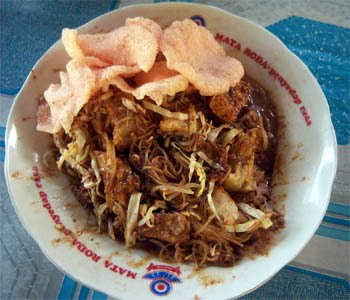
You may see other foods like gado-gado, ketoprak, soto mie, mie ayam or mie bakso, gorengan, rujak, siomay, and many more.

Gado-gado

‘Gado Gado’ literally means mixture. This dish is a mixture of boiled veggies, tofu, egg, corn, and shrimp crackers with peanut sauce


Ketoprak

Ketoprak is one of traditional food mostly sold by street vendors. Ketoprak offer’s delicious taste and it is quite filling, too. Usually it is eaten with steamed rice cake or lontong which made of rice stuffed into banana leaves shaped into a tube, then boiled until it’s ready to eat. Ketoprak is a mix of beansprouts, fried tofu, and boiled and rice-noodle in peanut sauce.


Soto Mie

Need something nice and warm… and I think a bowl of hot Soto Mie (noodle in beef soup). It is just the perfect comforting meal on a rainy day.


Mie Ayam

Indonesian Mie Ayam (chicken noodle soup) comprising a bowl of chicken stock, boiled choy sum, diced chicken cooked with sweet soy sauce and often added with tomato ketchup on top.


Or you can have meat balls on your noodle and it is called Mie Baso


Gorengan

Gorengan, literally means “fried things.” The golden offerings of this gorengan street hawkers included tahu (tofu), tempeh (bean curd), pisang (bananas), singkong (cassava), and ubi (sweet potato).


Es Campur

Es campur (mix shaved ice dessert) is a favourite Indonesian drink. At festivals, markets and other places where locals gather, you might see a stall selling es campur. The drink is made by placing shaved ice into a cup together with multi-colored jelly items, coconut, chocolate sauce and other items. Locals love the drink, tourists find it rather strange, but its worth a try.


In the evening…..

If you wish to have supper but no meals available in your fridge, no worries; there are also food hawkers in the evening! The choices may vary in other areas; sate ayam/kambing, tongseng, nasi goreng tek-tek, martabak etc.

Sate

Different regions in Indonesia have their different versions of sate. The famous Sate Ayam is from the island of Madura, off the coast of the central island, Java. It’s also very common to find this sate peddled on the streets as well as in five-star hotels in Jakarta. The lovely combination of lime juice, ground peanuts, chilies, and the sweet soy sauce makes it perfect. You have to try it at least once.


Tongseng

Tongseng Kambing, a kind of lamb curry from Solo, Central Java. This is one of my favorite dishes ever. You would find it sold on street vendors often together with Sate Kambing or lamb satay. Yes, it’s a typical street food, quite a famous one


Nasi Goreng Tek Tek

The fried rice street vendors are known as Tukang Nasi Goreng Tek – Tek (Tek – Tek Fried Rice man) because when they are selling around the neighborhood with their carts, instead of shouting, they always make a sound… “tek – tek – tek – tek” by tapping a wood.


Martabak Telor

Have you ever been in a moment when you are very really hungry in the middle of the night?? And potato chips or other snack just won’t fill your hunger for food? Don’t worry. Martabak telor is the perfect food for such situation. The name Martabak comes from the Arabic “muttabaq” meaning “folded” and telor means it contains egg.


Martabak Manis

This is the sweet version of martabak. It is filled with sugar, nuts and/or chocolate and topped with condensed milk.


How can you resist Jakarta?

Tuesday, May 25, 2010

SWEET MEMORY DISH


When I was a kid, I loved watching my Mom cooking in the kitchen.  One of my sweet memories ‘working in the kitchen’ with my mom was when she cooked a special dish for me named ‘Gadon’. This dish was cooked whenever I got sore throat or stomach-ache (of course without the chili on it) since it has soft texture and high nutrition.

I used to be fascinated by the unique taste of ‘gadon’. That memory has left me with an eternal soft spot for this ‘savoury soft beef cake’, a Javanese dish made from minced beef mixed with spices, egg and coconut milk, wrapped in banana leaves and then steamed.

People say childhood memories last forever, they may be right, because since then, whenever I cook ’gadon’ for my family, somewhere unknowing to myself a flash of that moment with my mom snaps back.

So, that takes me to today’s recipe, it is a dish very near and dear to me

GADON DAGING (‘SAVOURY SOFT BEEF CAKE’)

Ingredients

  • 300 grams minced beef
  • 2 eggs
  • 2 salam leaves
  • 2 kaffir lime leaves, thinly sliced
  • 4 red chilies, thinly sliced or whole bird-eye chilies
  • 100 ml thick coconut milk
  • Banana leaves for wrapping (note: in modern cooking, we can use aluminum foil)
Smooth ground spice mix

  • ½ – 1 teaspoon coriander seeds
  • 4 shallots
  • 3 cloves garlic
  • A pinch of salt
  • ½ teaspoon palm sugar
Cooking Method

  • Mix well the minced beef with coconut milk and egg
  • Add the smooth ground spice-mix to the meat-mix
  • Add in salam leaves and kaffir-lime leaves
  • Take one table-spoon-full of the meat-mix and put it on a piece of banana leaf
  • Top the meat with the chili slice (if you want it to have a kick)
  • Wrap the meat-mix with the banana leaf and seal it with a tooth pick (some people even use stappler).
  • Arrange the wrapped meat- mix on a steamer and steam for about 30 minutes or until well cooked
Serve warm

This was how my mom made gadon:


This was how I made gadon:


Look similar but not the same


Tuesday, April 13, 2010

MY FIRST ENCOUNTER WITH ASPARAGUS


Asparagus is not a native vegetable in Indonesia and it is not commonly used in everyday Indonesian dish. So far I've never bothered myself to think about cooking asparagus.

The first asparagus recipe that caught my attention was Grilled Asparagus wrapped with Proscuitto (by Hungry Girl) I found in LifestyleFood.com. The picture of the dish showed on the recipe was so mouth-watering that I couldn't resist the urge to try it out.

Fortunately, NOW is the right timing for this highly prized vegetable. The season for asparagus production is short, traditionally it begins in April and ends in mid summer. Due to the short growing season asparagus commands a premium. Moreover, in Jakarta where I live, asparagus is imported .....it cost me around 20 bucks for 20 stalks of fresh asparagus so I chose my daughter's birthday on last April 9th as the right occasion to cook these precious vegetables.

But before I cooked the asparagus, I want to learn more about it:

The fleshy green spears of asparagus are both succulent and tender and have been considered a delicacy since ancient times. Asparagus stalks should be rounded, and neither fat nor twisted. Look for firm, thin stems with deep green or purplish closed tips. The cut ends should not be too woody, although a little woodiness at the base prevents the stalk from drying out. Once trimmed and cooked, asparagus loses about half its total weight.

Use asparagus within a day or two after purchasing for best flavor. Store in the refrigerator with the ends wrapped in a damp paper towel, and be sure to place the asparagus in the back of the refrigerator away from any light, since folate is destroyed by exposure to air, heat or light.

Tips for Preparing Asparagus:

Asparagus can be served hot or cold. While it is not necessary to peel asparagus, you should cut off the woody base before cooking. Wash it under cold water to remove any sand or soil residues.You can tie asparagus stalks in a bundle to steam them, as this will make it easier to remove the stalks once cooked.
Avoid cooking asparagus in iron pots as the tannins in the asparagus can react with the iron and cause the stalks to become discolored.

And here is my version of  Bacon-Wrapped Asparagus

The original recipe used Prosciutto for the wrap but I consider prosciutto as similar to bacon so I used the available bacon from my refrigerator. For those who don’t eat pork, you can use beef bacon

Ingredients
  • 10- 20 asparagus spears
  • 10 -20 slices of bacon
  • 1 lemon (optional)

Before Grilling:
  • cut any thick woody ends from the asparagus and discard
  • add asparagus to a pan of boiling salted water
  • cook for 2-3 minutes or until the asparagus is bright green and tender
  • drain quickly and dry the stalks
  • wrap each one or two pieces of asparagus spear in a slice of bacon
  • to make the bacon stick to the asparagus I use tooth-pick.


The Grilling:

  • preheat barbecue grill or griddle plate
  • barbecue the asparagus
  • turning regularly until char marks appear
  • remove from grill
  • Optional: drizzle with a squeeze of lemon and season with pepper (*) this is based on Hungry Girl’s recipe. In my own version, I skip the lemon and pepper, I just love the taste of grilled bacon as it is.


Best when serve immediately.

Sunday, April 4, 2010

COOKING 'OUTSIDE THE WOK'


Along my delightful journey of cooking, I have tried different types of cooking methods: stir frying, deep frying, braising, and even slow cooking (all inside the wok) but so far never try ‘baking’.


Why not baking?

I thought I am not a baking type of a person and I did not even know how to handle the oven. I am the type of a person who prefers simple, easy and free style cooking, and to me baking sounds rather intimidating. For so long, I have been comfortable with cooking inside the wok …….

Until one morning …….

while sipping my coffee, I was craving for oatmeal cookies which I once bought at Star Buck. But I didn’t feel like going out that day and the nearest Star Buck Coffee is around 5 km away from my home …..then I said to myself ‘why not trying to make my own oatmeal cookies?’

But…it means I have to bake.

‘So what if you have to bake’, I challenged myself. The worst thing could happen is I screw-up the cookies. After weighing the pros and cons, I decided to give it a try and start ‘cooking outside the wok’ – get out my comfort zone and start to bake

I checked my kitchen cabinet and yes, I found a bag of oatmeal, brown sugar and unsalted butter. I thought these 3 ingredients were sufficient to create the cookies. I got excited…and here was my simple oatmeal cookies experiment

Ingredients

  • 100 gram quick cook oatmeal
  • 3 tablespoons brown sugar
  • 50 gram unsalted butter – leave at room temperature to melt
  • 5 tablespoons water
Method

  • Combine the oats, brown sugar, water and melted butter
  • Mix the combined ingredients thoroughly into a dough (note: it would be nicer if the dough is added with raisins coz raisins will give more flavor to the cookies).

  • Take 1 tablepoon of the dough and shape it into a cookie-form
  • Repeat until no dough remains and you will get around 24 cookies
  • Cover the base of a baking pan with aluminum foil
  • Arrange the cookies on the pan


  • Bake in pre-heated oven at 150 degree Celsius (or 300 degree F or Mark 2) with both upper and bottom flame for 30 minutes.

Hey, finally I can bake… and it’s not as intimidating as I thought. And my invented oatmeal cookies were not bad at all …. I love the cookies and it goes very well as ‘the companion of a cup of hot coffee’.